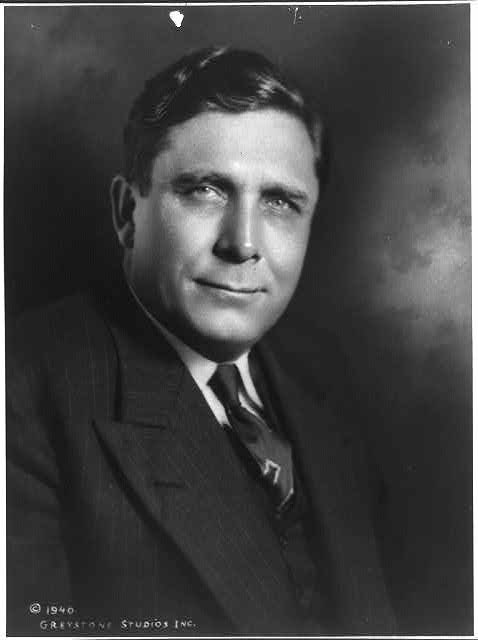
Wendell Willkie
Republican presidential nominee, 1940
 Republican
Biography
American lawyer and utility executive (president of Commonwealth & Southern) who was the Republican nominee for President in 1940 and lost to Franklin D. Roosevelt. Ayn Rand and her husband Frank O'Connor were full-time volunteers for his 1940 campaign. He lost 449 to 82 in the Electoral College and 54.7% to 44.8% in the popular vote (Wikipedia, 1940 United States presidential election); the full analysis is on his Atlas page.
How close did Willkie come in 1940?
Not close in the Electoral College: Roosevelt carried 38 states and 449 electoral votes to Willkie's 10 states and 82, and won the popular vote 27,313,945 (54.7%) to 22,347,744 (44.8%), a margin of 4,966,201 votes.
Gallup's last poll (November 2) had Roosevelt ahead 51.1% to 47.4%, a smaller lead than the 9.9 points he won by; Gallup's own June 11 poll had been 52.7% to 29.9% with 17.3% undecided. The same article says Gallup declined to predict a winner, citing a four-point margin of error (Katz, Public Opinion Quarterly, 1941).
Tipping point (our arithmetic): put the states Roosevelt won in order of his percentage margin, smallest first. Willkie starts with 82 electoral votes and needs 266. Wisconsin, Illinois, New York, New Jersey, Minnesota, Ohio, Missouri, Wyoming, New Hampshire and Massachusetts add 180, only 262 in all; Pennsylvania (36, Roosevelt by 6.9 points) takes him to 298. Roosevelt's margins in those eleven states total 1,145,860 votes.
Facts the article records: Willkie won over six million more votes than Landon in 1936 and over 57% of the farm vote, while Roosevelt carried every city over 400,000 people except Cincinnati. Reasons the article gives, citing historians (Jeffries 2017; Neal 1989; Evjen 1952): Willkie campaigned against a third term ("if one man is indispensable, then none of us is free"), but many voters still blamed business leaders for the Depression and Willkie symbolized big business; his utility company competed with the TVA; he was nominated on the sixth ballot over the Taft isolationists and Dewey, leaving the party split over aid to Britain; and Roosevelt promised not to send American boys into foreign wars. Which of these mattered most is the historians' judgment, not a counted fact.
| Popular vote | 27,313,945 (54.7%) to 22,347,744 (44.8%) |
|---|---|
| Electoral vote | 449 to 82 (266 needed) |
| States carried | 38 to 10 |
| Margin | 4,966,201 votes (9.9 points) |
| Tipping-point margin | Pennsylvania: Roosevelt by 281,187 votes (6.9 points) |
| Final Gallup poll (Nov 2) | Roosevelt 51.1%, Willkie 47.4% |
Sources: Wikipedia: 1940 United States presidential election; State results (uselectionatlas.org)